CJC-1295: Mechanism, Research Background, and Laboratory Use
What Is CJC-1295?
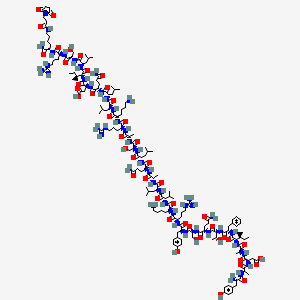
CJC-1295 is a synthetic analog of growth hormone-releasing hormone (GHRH), engineered from the first 29 amino acids of native GHRH (the same core fragment sometimes called Mod GRF 1-29 or “CJC-1295 without DAC”) with amino acid substitutions that resist enzymatic breakdown. A separate variant, CJC-1295 with DAC (Drug Affinity Complex), adds a maleimide group that binds circulating albumin, extending the peptide’s working half-life from roughly 30 minutes to several days. The product sold by Pure Chain Aminos is the shorter-acting no-DAC variant, frequently studied in combination with GHRP-class peptides such as Ipamorelin.
Mechanism of Action
Like other GHRH analogs, CJC-1295 binds the growth hormone-releasing hormone receptor (GHRHR) on pituitary somatotroph cells, activating the Gs/adenylyl cyclase/cAMP/PKA signaling cascade that drives growth hormone synthesis and pulsatile release. Because GHRH-receptor activation and ghrelin-receptor (GHS-R1a) activation work through separate, complementary pathways, CJC-1295 is commonly studied alongside GHRP-class or ghrelin-mimetic peptides like Ipamorelin — a combination that research literature has associated with a larger GH pulse than either compound produces on its own, since one pathway increases the releasable GH pool while the other amplifies pulse amplitude.
Research Background
CJC-1295 has been studied for its receptor-binding characteristics, its resistance to enzymatic degradation relative to native GHRH, and its pharmacodynamic effect on GH and IGF-1 levels in laboratory settings. Its role as a stacking partner for GHRP-class peptides makes it a frequent subject of comparative research alongside Ipamorelin, Tesamorelin, and Sermorelin, examining differences in half-life, receptor binding duration, and downstream GH pulse characteristics across GHRH-class research compounds.
Laboratory Handling and Storage
CJC-1295 is supplied as a lyophilized (freeze-dried) powder and should be stored refrigerated or frozen prior to reconstitution, protected from light. Once reconstituted with bacteriostatic water, the solution should be kept refrigerated and used within the timeframe established by the researcher’s own protocol — the no-DAC variant in particular has a short working half-life, and researchers commonly account for more frequent dosing intervals in study protocols as a result. Standard laboratory peptide-handling practice — sterile technique, minimal freeze-thaw cycling, and accurate labeling with reconstitution date — applies.
Frequently Asked Questions
What is CJC-1295?
CJC-1295 is a synthetic GHRH analog built from the first 29 amino acids of native GHRH, modified to resist enzymatic breakdown. The no-DAC variant sold by Pure Chain Aminos is often studied alongside GHRP-class peptides such as Ipamorelin.
What’s the difference between CJC-1295 with DAC and without DAC?
CJC-1295 with DAC adds a Drug Affinity Complex that binds albumin, extending its working half-life to several days. The no-DAC variant (also called Mod GRF 1-29) has a much shorter half-life of roughly 30 minutes.
Why is CJC-1295 often studied alongside GHRP-class peptides like Ipamorelin?
GHRH analogs like CJC-1295 and ghrelin-mimetic GHRPs like Ipamorelin act on separate receptor pathways that complement each other — one increases the releasable growth hormone pool while the other amplifies pulse amplitude, which research literature has associated with a larger combined GH pulse.
How should CJC-1295 be stored and reconstituted?
Store the lyophilized powder refrigerated or frozen and protected from light. After reconstitution with bacteriostatic water, keep refrigerated and use within the researcher’s established timeframe, accounting for the no-DAC variant’s short working half-life.
Is CJC-1295 approved for any use?
No. Unlike Tesamorelin, CJC-1295 does not have FDA approval for any indication and is sold strictly as a laboratory research compound.
Disclaimer
This content is provided for laboratory research purposes only and is not intended as guidance for human or animal use. CJC-1295, as sold by Pure Chain Aminos, is a research compound and is not evaluated or approved by the FDA for over-the-counter sale or self-administration. Nothing on this page constitutes medical advice, and no claims are made regarding safety or efficacy in humans or animals outside of a controlled research setting.
More compound research notes
- Selank: Mechanism, Research Background, and Laboratory Use
- Semax: Mechanism, Research Background, and Laboratory Use
- Epitalon: Mechanism, Research Background, and Laboratory Use
- KPV: Mechanism, Research Background, and Laboratory Use
- Sermorelin: Mechanism, Research Background, and Laboratory Use
- Tesamorelin: Mechanism, Research Background, and Laboratory Use
- GHK-Cu: Mechanism, Research Background, and Laboratory Use
- Ipamorelin: Mechanism, Research Background, and Laboratory Use