Ipamorelin: Mechanism, Research Background, and Laboratory Use
What Is Ipamorelin?
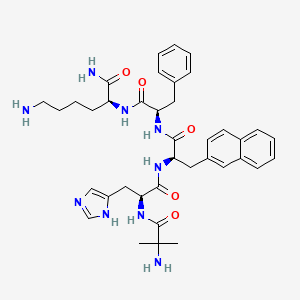
Ipamorelin is a pentapeptide classified as a growth hormone secretagogue (GHS) and a selective agonist of the ghrelin/growth hormone secretagogue receptor (GHS-R1a). It was originally developed in the 1990s as part of a research program searching for GH-releasing compounds with a cleaner selectivity profile than earlier secretagogues like GHRP-6. Its five-amino-acid sequence (Aib-His-D-2-Nal-D-Phe-Lys-NH2) is the basis for its high receptor selectivity relative to older growth hormone-releasing peptides.
In laboratory settings, Ipamorelin is used almost exclusively in in vitro and animal-model research examining growth hormone pulsatility, ghrelin receptor pharmacology, and downstream signaling in bone, muscle, and metabolic tissue. It is not approved by the FDA for human or veterinary use and is not a drug, dietary supplement, or food product. Pure Chain Aminos sells Ipamorelin strictly for in vitro laboratory research and educational use by qualified researchers.
Mechanism of Action
Ipamorelin binds the GHS-R1a receptor, the same receptor targeted endogenously by ghrelin. Receptor activation triggers a signaling cascade (largely Gq/11-coupled, with downstream phospholipase C and protein kinase C involvement) in somatotroph cells of the anterior pituitary, which in model systems has been observed to stimulate pulsatile release of growth hormone (GH). Because Ipamorelin’s binding is highly selective for GHS-R1a, published in vitro and animal-model research has reported that it does not meaningfully stimulate release of cortisol, prolactin, or ACTH at the concentrations tested — a key distinction researchers cite versus earlier-generation secretagogues such as GHRP-6 and GHRP-2, which show more cross-reactivity with other pituitary hormone pathways in the same model systems.
This selectivity is the primary reason Ipamorelin is frequently used as a pharmacological tool compound in receptor-selectivity and GH-axis research: it allows investigators to probe GHS-R1a-specific signaling with reduced confounding from off-target hormone release.
Research Background
Ipamorelin has been studied in published research across several areas:
- GH secretion dynamics: early pharmacology studies characterized its dose-dependent, pulsatile GH-releasing effect in animal models and isolated pituitary cell assays.
- Bone metabolism research: rodent studies have examined GHS-R1a agonism in the context of bone mineral density and fracture-healing models, given GH’s role in skeletal metabolism.
- Gastrointestinal motility models: because GHS-R1a is also expressed outside the pituitary, some research has examined ghrelin-receptor agonists, including Ipamorelin, in models of postoperative ileus and GI motility.
- Combination research protocols: in laboratory settings, Ipamorelin is frequently studied alongside GHRH-analog peptides (such as CJC-1295) to examine synergistic effects on GH pulse amplitude in animal models, since the two act on different receptors (GHS-R1a vs. GHRH receptor) in the same axis.
As with all research peptides sold by Pure Chain Aminos, none of the above describes an approved or intended use of the product sold on this site. It is a summary of the kind of questions researchers use this compound to investigate in a laboratory setting.
Laboratory Handling and Storage
Ipamorelin is supplied as a lyophilized (freeze-dried) powder and should be handled only by trained personnel using appropriate laboratory practice:
- Store lyophilized vials at -20°C for long-term storage; product is shipped with appropriate cold-chain packaging.
- Reconstitute only with bacteriostatic water or sterile water for research purposes, using standard aseptic technique in a controlled laboratory environment.
- Once reconstituted, store refrigerated (2–8°C) and use within the timeframe appropriate for the specific research protocol; peptide stability in solution is time- and temperature-sensitive.
- Avoid repeated freeze-thaw cycles, which can degrade peptide integrity and confound experimental results.
Every batch of Ipamorelin sold by Pure Chain Aminos ships with a batch-specific third-party Certificate of Analysis (CoA), including HPLC purity data and mass spectrometry identity confirmation, so researchers can verify material identity and purity before use in their protocols.
Frequently Asked Questions
What is Ipamorelin used for in research?
Ipamorelin is used in laboratory research as a selective growth hormone secretagogue receptor (GHS-R1a) agonist. Researchers use it to study growth hormone secretion dynamics, receptor selectivity, and related signaling pathways in in vitro and animal-model settings. It is not intended for human or animal use.
How is Ipamorelin different from GHRP-6 or GHRP-2?
Published in vitro and animal-model research indicates that Ipamorelin is more selective for the GHS-R1a receptor than earlier-generation secretagogues like GHRP-6 and GHRP-2, which show more cross-reactivity with cortisol, prolactin, and ACTH release in the same model systems. This selectivity is why researchers often choose Ipamorelin as a pharmacological tool compound.
Does Pure Chain Aminos verify the purity of its Ipamorelin?
Yes. Every batch of Ipamorelin sold by Pure Chain Aminos ships with a batch-specific third-party Certificate of Analysis (CoA), including HPLC purity data and mass spectrometry identity confirmation, so researchers can verify material identity and purity before use in their protocols.
How should Ipamorelin be stored?
Lyophilized Ipamorelin should be stored at -20°C for long-term storage and reconstituted only with bacteriostatic or sterile water using aseptic technique. Once reconstituted, it should be refrigerated at 2–8°C and used within the timeframe appropriate to the research protocol, avoiding repeated freeze-thaw cycles.
Is Ipamorelin approved for human or animal use?
No. Ipamorelin is not approved by the FDA for human or animal use and is sold by Pure Chain Aminos strictly for in vitro laboratory research by qualified professionals and institutions. It is not a drug, dietary supplement, cosmetic, or food product.
Disclaimer
Ipamorelin is sold by Pure Chain Aminos strictly for in vitro laboratory research use by qualified professionals and institutions. It is not a drug, dietary supplement, cosmetic, or food product, and it is not approved by the FDA for human or animal use. Nothing on this page constitutes medical advice, and no claims are made regarding safety, efficacy, or suitability for use in or on humans or animals. All information above reflects published laboratory and animal-model research only; Pure Chain Aminos does not condone or support any use of this product outside of qualified laboratory research settings.
More compound research notes
- Selank: Mechanism, Research Background, and Laboratory Use
- Semax: Mechanism, Research Background, and Laboratory Use
- Epitalon: Mechanism, Research Background, and Laboratory Use
- KPV: Mechanism, Research Background, and Laboratory Use
- Sermorelin: Mechanism, Research Background, and Laboratory Use
- CJC-1295: Mechanism, Research Background, and Laboratory Use
- Tesamorelin: Mechanism, Research Background, and Laboratory Use
- GHK-Cu: Mechanism, Research Background, and Laboratory Use