GHK-Cu: Mechanism, Research Background, and Laboratory Use
What Is GHK-Cu?
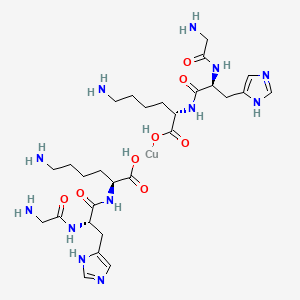
GHK-Cu (copper peptide GHK-Cu, also written as Cu-GHK) is a naturally occurring copper complex of the tripeptide glycyl-L-histidyl-L-lysine (GHK). The free tripeptide GHK was first isolated from human plasma in the 1970s, where researchers observed it decreases with age; its copper-binding form, GHK-Cu, has since become one of the most widely studied copper peptides in laboratory dermatology, wound-healing, and tissue-remodeling research.
Pure Chain Aminos sells GHK-Cu strictly for in vitro laboratory research and educational use by qualified researchers. It is not approved by the FDA for human or animal use, and it is not a drug, cosmetic, dietary supplement, or food product.
Mechanism of Action
GHK-Cu’s research interest centers on its role as a copper-delivery and signaling peptide. In cell-culture and animal-model studies, GHK-Cu has been reported to interact with several biological pathways relevant to tissue remodeling:
- Copper transport and enzyme cofactor delivery: copper is a required cofactor for enzymes such as lysyl oxidase (involved in collagen and elastin cross-linking) and superoxide dismutase (an antioxidant enzyme); GHK-Cu research has examined its role in delivering and regulating cellular copper availability.
- Extracellular matrix remodeling: in vitro fibroblast studies have reported GHK-Cu’s association with increased collagen and glycosaminoglycan synthesis, markers relevant to connective-tissue research models.
- Gene-expression modulation: microarray-based research has reported that GHK-Cu can influence expression of genes involved in tissue repair, antioxidant response, and anti-inflammatory pathways in cultured cell models.
Research Background
Published laboratory and animal-model research on GHK-Cu spans several domains:
- Dermatology and skin research: cell-culture and animal studies have examined GHK-Cu’s effects on fibroblast activity, collagen synthesis, and antioxidant markers in skin-model systems.
- Wound-healing models: animal studies have investigated GHK-Cu in the context of tissue-repair signaling and matrix remodeling following injury.
- Hair-follicle research: in vitro studies have examined copper peptides, including GHK-Cu, in the context of follicle growth-cycle signaling models.
- Antioxidant and anti-inflammatory signaling: laboratory research has studied GHK-Cu’s reported modulation of oxidative-stress and inflammatory markers in cultured cell systems.
As with all research peptides sold by Pure Chain Aminos, this summary reflects published laboratory and animal-model research only, not an approved or intended use of the product sold on this site.
Laboratory Handling and Storage
GHK-Cu is supplied as a lyophilized powder and should be handled only by trained personnel using appropriate laboratory practice:
- Store lyophilized vials at -20°C for long-term storage; product ships with appropriate cold-chain packaging.
- Reconstitute only with bacteriostatic water or sterile water for research purposes, using standard aseptic technique in a controlled laboratory environment.
- Once reconstituted, store refrigerated (2–8°C) and use within the timeframe appropriate for the specific research protocol.
- Protect from prolonged light exposure and avoid repeated freeze-thaw cycles, which can degrade peptide integrity.
Every batch of GHK-Cu sold by Pure Chain Aminos ships with a batch-specific third-party Certificate of Analysis (CoA), including HPLC purity data and mass spectrometry identity confirmation, so researchers can verify material identity and purity before use in their protocols.
Frequently Asked Questions
What is GHK-Cu used for in research?
GHK-Cu is a copper-binding tripeptide studied in laboratory research for its reported roles in copper delivery, extracellular matrix remodeling, and gene-expression modulation. It is commonly used as a research tool in dermatology, wound-healing, and tissue-remodeling studies in cell culture and animal models. It is not intended for human or animal use.
What is the difference between GHK and GHK-Cu?
GHK is the free tripeptide (glycyl-L-histidyl-L-lysine) first isolated from human plasma. GHK-Cu is its copper-bound complex, which is the form most commonly used in published laboratory research because of its role in copper transport and enzyme cofactor delivery.
Does Pure Chain Aminos verify the purity of its GHK-Cu?
Yes. Every batch of GHK-Cu sold by Pure Chain Aminos ships with a batch-specific third-party Certificate of Analysis (CoA), including HPLC purity data and mass spectrometry identity confirmation, so researchers can verify material identity and purity before use in their protocols.
How should GHK-Cu be stored?
Lyophilized GHK-Cu should be stored at -20°C for long-term storage and reconstituted only with bacteriostatic or sterile water using aseptic technique. Once reconstituted, it should be refrigerated at 2–8°C, protected from prolonged light exposure, and used within the timeframe appropriate to the research protocol.
Is GHK-Cu approved for human or cosmetic use?
No. GHK-Cu is not approved by the FDA for human or animal use and is sold by Pure Chain Aminos strictly for in vitro laboratory research by qualified professionals and institutions. It is not a drug, dietary supplement, cosmetic, or food product.
Disclaimer
GHK-Cu is sold by Pure Chain Aminos strictly for in vitro laboratory research use by qualified professionals and institutions. It is not a drug, dietary supplement, cosmetic, or food product, and it is not approved by the FDA for human or animal use. Nothing on this page constitutes medical or cosmetic advice, and no claims are made regarding safety, efficacy, or suitability for use in or on humans or animals. All information above reflects published laboratory and animal-model research only; Pure Chain Aminos does not condone or support any use of this product outside of qualified laboratory research settings.
More compound research notes
- Selank: Mechanism, Research Background, and Laboratory Use
- Semax: Mechanism, Research Background, and Laboratory Use
- Epitalon: Mechanism, Research Background, and Laboratory Use
- KPV: Mechanism, Research Background, and Laboratory Use
- Sermorelin: Mechanism, Research Background, and Laboratory Use
- CJC-1295: Mechanism, Research Background, and Laboratory Use
- Tesamorelin: Mechanism, Research Background, and Laboratory Use
- Ipamorelin: Mechanism, Research Background, and Laboratory Use