“99% Pure” Isn’t the Whole Story: What Peptide Purity Really Tells You
A label that says “99% pure” sounds like the end of the conversation. It is not. Purity is one number from one test, and it can be reported in ways that make a sample look better than it is. Here is what the number does and does not mean.
What HPLC purity actually measures
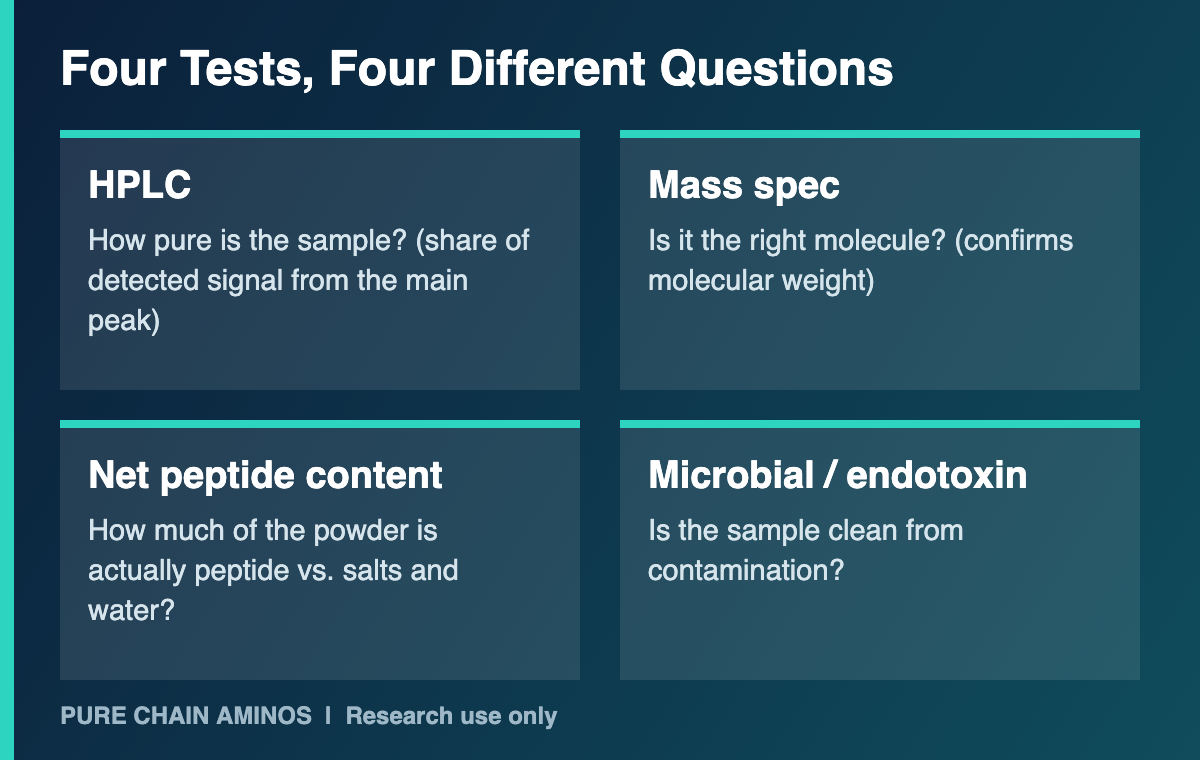
High-performance liquid chromatography separates the components of a sample and shows them as peaks. Reported purity is usually the area of the main peak divided by the total area of all detected peaks. That is useful, but it only counts what the detector can see at the chosen settings.
Purity is not identity
A clean, single peak says the sample is one substance. It does not say it is the right one. Mass spectrometry confirms the molecular weight, which is how you check that the peptide matches what the label says.
Purity is not content
Lyophilized peptide powder also contains counter-ions such as TFA salts, plus residual water. Net peptide content describes how much of the powder is actually peptide. Two vials with the same HPLC purity can contain different amounts of peptide.
Purity is not cleanliness
Microbial and endotoxin testing answer a separate question: whether the sample was handled and produced without contamination. A high HPLC number says nothing about it.
Five questions to ask any supplier
- Is the COA specific to this lot, with a test date?
- Which methods were used, and were both HPLC and mass spectrometry run?
- Can I see the actual chromatogram, not just a summary number?
- Is net peptide content reported, or only purity?
- Is microbial or endotoxin testing included?
Why we put the data in front of you
At Pure Chain Aminos, every batch ships with a Certificate of Analysis, and our testing includes HPLC, mass spectrometry and microbiological analysis. See the details on our lab testing information page, and learn how to check any report in our COA guide.
All products from Pure Chain Aminos are sold for laboratory research use only and are not for human or veterinary consumption. This article is educational and is not medical advice.
Related reading: 7 red flags when buying research peptides online.