7 Red Flags When Buying Research Peptides Online
Search for research peptides and you will find hundreds of vendors, and they are not equal. Some publish real batch data. Others publish a nice-looking PDF and a promise. Before you order, run through these seven red flags.
1. The COA is generic, not batch-specific
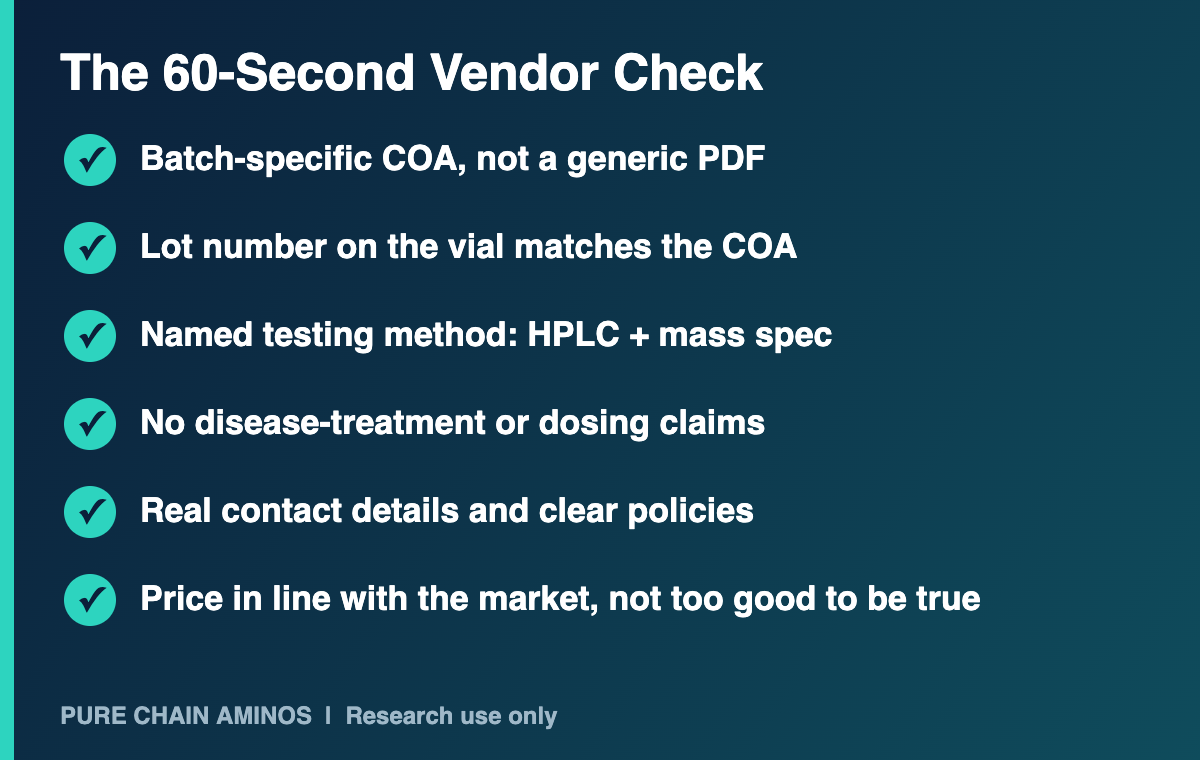
A Certificate of Analysis should name a specific lot and test date. If the same PDF is attached to every product, or the lot number is missing, you have a marketing document, not a test result.
2. The lot number on your vial does not match the report
A real COA can be traced to the vial in your hand. If you cannot match the two, you cannot know what was tested.
3. Testing methods are vague
“Lab tested” tells you nothing. Look for named methods such as HPLC for purity and mass spectrometry for identity. Pure Chain Aminos, for example, states that it uses HPLC, mass spectrometry and microbiological testing and provides a COA for every batch.
4. The site makes medical claims
Research-grade materials are not approved treatments. Any vendor promising cures, dosing protocols or results for human use is ignoring the rules that protect you and them. Reputable suppliers keep language to laboratory research.
5. The price is far below the market
Synthesis, purification and testing cost money. A price that is a fraction of everyone else’s usually means a shortcut somewhere, often in the testing.
6. No real company information
Look for a working contact method, clear shipping and refund policies, and terms of sale. Anonymous storefronts that vanish after a purchase are a classic warning sign.
7. Reviews and social proof look manufactured
Identical five-star reviews, no dates, and testimonials describing personal health outcomes are all signs the proof was written for the page, not by customers.
The quick takeaway
Save the checklist above and apply it to any supplier, including us. A trustworthy vendor will welcome the questions. If you want to go deeper, read our guide on how to read a COA and catch a fake one.
All products from Pure Chain Aminos are sold for laboratory research use only and are not for human or veterinary consumption. This article is educational and is not medical advice.
Related reading: why “99% pure” isn’t the whole story.